My Mythical Menagerie series is currently making its way into German, and when I first decided to translate the books, I thought I had a reasonable idea of what that would involve.
You take the English book. You translate it into German. You make sure the translation is correct. And then you have a German book.
Simple.
Except, apparently, not.
Because when you’ve spent years creating an entire fantasy world full of mythical creatures, magical terminology, secret organisations, place names and jokes, translating that world involves a lot more than finding the equivalent words in another language.
And over the past few months, I’ve encountered some wonderfully strange problems along the way.
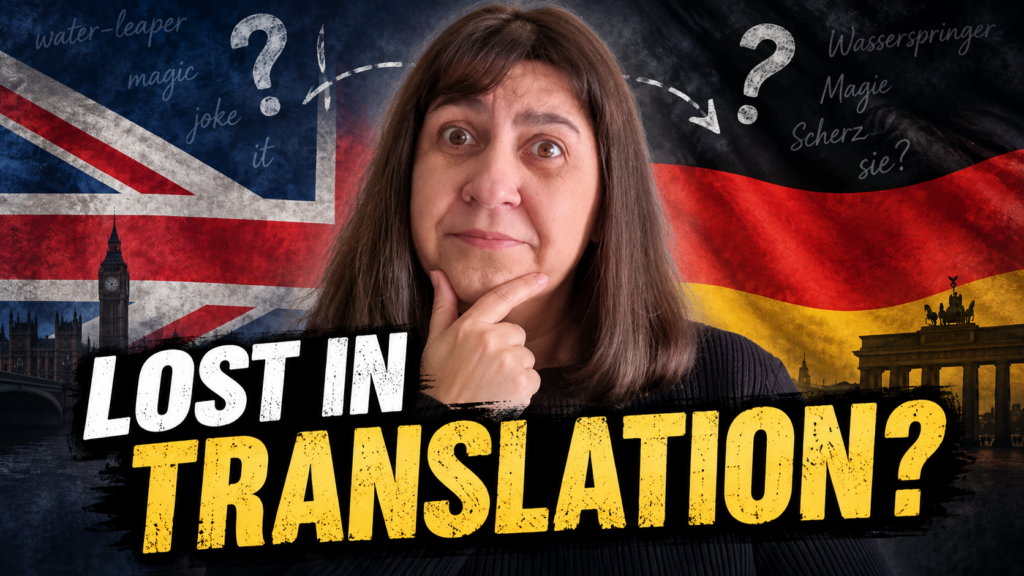
What Do You Call a Mythical Creature in German?
This was one of the first questions I had to answer.
Some creatures are easy. Werewolves and unicorns have well-established German names, so there’s not much to agonise over.
But the Mythical Menagerie isn’t exactly known for sticking to the famous creatures.
There’s the water-leaper, for example, a wonderfully bizarre creature from Welsh folklore. In the German books, it became a Wasserspringer — essentially a direct translation of its English name.
Then there’s the caladrius, the magical white bird from medieval legend that can supposedly predict whether a sick person will recover. In German, that became Kaladrius.
So far, so good.
But what about the creatures whose names weren’t English to begin with?
My latest prequel, Hunter’s Calling, is set in Thailand and features creatures including the Japanese ningyo and the Thai nguek, as well as a naga and a kinnaree.
Those names remain exactly what they are.
They’re not just arbitrary fantasy words. They belong to the cultures and folklore the creatures came from, and translating them would strip away part of that identity.
Which means there’s a constant balancing act between making something understandable to a German reader and preserving the mythology that inspired it.
When English Names Need to Stay English
Most of the Mythical Menagerie series takes place in England. My characters visit pubs, businesses, buildings and other locations with English names.
Should those names suddenly become German?
Well… no.
If Ambrose walks into an English pub called The Red Lion, the pub hasn’t magically relocated to Germany just because the person reading about it is German.
This sounds ridiculously obvious when put like that.
But across an entire fantasy series, the distinction becomes surprisingly important. Is something written in English simply because I wrote the original book in English? Or is it in English because the characters are standing in London?
Place names, businesses and institutions that exist within the English setting generally need to retain that local flavour. But other terms exist because the reader needs to understand what they mean.
And suddenly I’m having very serious debates with myself over things I barely thought about when I wrote them.
Past Me Created a Lot of Problems for Future Me
Of course, I didn’t just use existing words and names.
I also invented things.
In the Mythical Menagerie series, magic can be performed using spoken Words of Wonder or written Symbols. People can possess magical Traits. There are Keeper’s Fees, hidden sanctuaries known as folds, secret organisations and magical artefacts. And then there’s the Repository, where mythical creatures are kept.
Every one of those terms was a decision I made while writing the books in English.
Now every one of them has to become another decision in German.
Should it be translated at all? Does the German term have precisely the same meaning? Does it still sound like something that belongs in a fantasy novel? Does it have an unintended meaning I hadn’t considered?
And, perhaps most importantly: Did I call it the same thing three books ago?
I now have a German glossary for which Future Me is very grateful.
When the Joke Simply Doesn’t Translate
My favourite translation problems, however, are the ones where something works perfectly well in English… and then falls apart completely in German.
I recently found a fantastic example while working on the German translation of Hunter’s Calling.
The main character, Ben, is in Thailand. One of the Thai characters speaks to him in slightly broken English and says:
“Pradit say you come. Say you need to blow some steam.”
Ben automatically corrects him:
“Blow off.”
The correct English expression is, of course, blow off some steam.
But there’s also a tiny joke hiding in the mistake, because without the off, the word blow can have a rather different meaning.
So the exchange does several things at once. It shows that the character’s English isn’t perfect, Ben automatically corrects him, and there’s a slightly rude accidental joke lurking underneath it all.
Then I looked at the German translation.
The character essentially said:
“You need to let off some steam.”
And Ben replied:
“Let off some steam.”
Well done, Ben. Very helpful.
The problem is that the original mistake doesn’t exist in the German translation. And without the mistake, there’s nothing for Ben to correct. More importantly, the accidental innuendo has disappeared as well.
A perfectly accurate translation of the individual words had produced a scene that no longer made sense.
That has been one of the most interesting lessons of this entire process.
Sometimes it isn’t enough to translate what the words mean.
You have to translate what the words are doing.
And Sometimes Grammar Adds Something You Never Wrote
German has also occasionally demanded information that I never needed to provide in English.
Once again, Hunter’s Calling gave me a particularly good example.
At one point, Ben is fighting a naga — a giant serpentine creature — which has another character in its grip.
Ben thinks:
It’s killing her.
Three very simple words.
English conveniently gives me the pronoun it. German, however, has grammatical gender. And one version of the translation came back as:
She’s killing her.
Wait. She?
Who’s killing who now? And did I ever say the naga was female?
English had quite happily allowed me to avoid the question altogether. German looked at my giant mythical snake and apparently decided I had some choices to make.
It’s a tiny thing, but it perfectly illustrates how moving a story into another language can introduce information that simply wasn’t present in the original.
Translating More Than Words
Before I started this process, I thought translating my books would mostly involve finding the correct German words for the English ones.
Instead, I’ve found myself going back over decisions I made years ago and examining what those words were actually supposed to accomplish.
Is something a name or a description?
Is it English because the book was written in English, or because the story takes place in England?
Is the literal meaning of a sentence more important than the joke hidden inside it?
And, apparently, is that giant mythical snake male or female?
These are not questions I expected to be asking.
But the process has been fascinating, because it made me realise just how much information is hiding inside the language of a fantasy novel — things we barely notice until we try to move an entire fictional world from one language into another.
And I have considerably more sympathy for translators now.
Especially when the author has filled her books with obscure mythical creatures, invented magical terminology and terrible jokes.
Have you ever read the same book in two different languages? Did you notice anything that changed — or got completely lost — in translation?
