Writers often talk about the pain of finishing a first draft and discovering that they’ve written 120,000 words when they were aiming for 80,000. Then comes the agonising process of cutting scenes, killing darlings, and somehow losing 40,000 words without destroying the story in the process.
I have the opposite problem.
I’m an underwriter.
Give me a story to tell and I’ll apparently find the most efficient route from beginning to end, arrive 40,000 words early, and wonder what everybody else has been doing all this time.
This isn’t exactly a new discovery. In fact, it’s one of the reasons the Mythical Menagerie series exists in its current form.
How the Mythical Menagerie Became a Series of Stories
Back in 2017, when I was still a very newbie writer, I became fascinated by the idea of serialised fiction.
I’d written a few short stories by then, but I’d never managed to write an entire novel. Not for lack of trying. There was just something incredibly intimidating about sitting down and thinking, Right. Now I need to write 80,000 words.
But 10,000 words?
I could do that. And so I came up with a plan.
Instead of writing a novel, I would write a series of shorter adventures. Each would tell a complete story with its own beginning, middle and end, but together they would build towards a much larger overarching story.
And then I would publish each adventure as I finished it.
It seemed like the perfect solution.
My first Mythical Menagerie story, Beginner’s Luck, came in at around 10,000 words. I published it, promoted it, and lots of people read it.
I followed it with Banshee’s Wail and then Asrai’s Curse. The stories were getting progressively longer as I learned how to write, but something else was happening at the same time.
My sales were going down.
Eventually, a reader comment on Amazon made me realise what the problem was. Readers were essentially paying the price of a cheap novel for each individual short story.
They were enjoying the stories. They just weren’t particularly happy about paying for them one at a time.
Which, frankly, was fair enough.
So I unpublished the first three stories, knuckled down and wrote another three. Those six adventures together formed the complete story arc of what eventually became Myth Hunter.
And because that was how the Mythical Menagerie began, I continued writing the rest of the series in much the same way.
Each book is essentially made up of several interconnected stories of around 15,000–20,000 words. They each have their own mini-arcs, while also moving the larger plot of the novel — and eventually the entire series — forward.
It’s unconventional, but it worked remarkably well for me.
Instead of having to write an 80,000-word novel, I only ever had to write the next 20,000-word adventure.
But Now I Want to Write Something Bigger
The problem is that I’m now starting a completely new series.
New world. New characters. New story.
And this time, I want to challenge myself to write it as a more traditional novel. I’m aiming for at least 60,000 words for the first book, although I’d really like to get closer to 80,000.
There’s just one small problem: I don’t actually know how to do that.
I know how to tell a complete story in 20,000 words. What I don’t want to do is take one of those stories and stretch it until it’s three or four times as long.
Because surely the goal isn’t simply to write more words.
The goal is to tell a bigger story — one that actually needs 60,000 or 80,000 words to tell properly.
So how do I do that?
I have a few ideas…
Building a Bigger Story
I’ve been studying story structures like Save the Cat! and the Hero’s Journey, looking at how longer stories develop and where their major turning points tend to fall.
I can absolutely see why writers use these structures. They’re useful tools for understanding why stories work and for making sure a plot doesn’t wander off into the wilderness somewhere around chapter seventeen.
But I’m also slightly wary of them.
I don’t want someone to reach the 25% mark of my book and think, Ah yes. Here comes the Fun and Games section.
Or get to the final third and realise that the hero’s lowest point has arrived exactly on schedule.
Obviously stories need structure. But I want mine to feel as though events are unfolding naturally, rather than as if I’m ticking boxes on a template.
So one of my challenges is going to be finding that balance: creating a plot complex enough to sustain a full-length novel without making the underlying structure too visible.
Learning to See My Own Worlds
Another area I want to work on is description, which has never come particularly naturally to me.
A friend of mine is a huge fan of Steven Erikson’s Malazan Book of the Fallen, and he used to send me passages showing the incredible level of detail Erikson puts into his characters and settings.
I would read them and think: Yeah. I can’t do that.
Or, at least, I don’t naturally write that way.
I suspect some of this may be connected to the way I visualise things. I have aphantasia, so I don’t form clear mental pictures in the way some people do.
I’ve heard people describe reading as watching a movie inside their heads, complete with detailed scenery and characters.
That sounds lovely.
My characters are mostly faceless blobs wandering around vaguely defined locations.
I know what things generally look like. But I don’t have that detailed mental movie playing in front of me.
Which means those visual details don’t necessarily occur to me when I’m writing either.
That’s something I want to work on with this new series — not because I want to start spending three pages describing a tree, but because richer description could make the world itself feel more tangible and immersive.
If that also happens to increase the word count, I certainly won’t complain.
Letting the Story Wander a Little
I also tend to write very linearly.
My protagonist has an objective. Something needs to happen for him to achieve that objective. So he does the thing, which leads to the next thing, which leads to the next thing…
And eventually we arrive at the end.
Efficient!
Perhaps too efficient.
There are usually other things happening around that main storyline, but I don’t necessarily give those threads enough room to develop.
So with this new series, I want to experiment with subplots and allow some of those secondary stories to breathe.
Not filler added purely for the sake of making the book longer – actual stories happening alongside the main one that add something to the characters, the world, or the central conflict.
And Maybe More Than One Point of View?
Then there’s another possibility.
With a few notable exceptions, my stories tend to stay very closely with one protagonist.
But what if they didn’t?
Multiple viewpoint characters could allow me to explore parts of the world and story that my protagonist simply can’t see. A second character doesn’t have to exist merely to increase the word count; they could have their own goals, conflicts and perspective on whatever is happening.
I have no idea yet whether that will suit this particular series. But it’s something I’m willing to play with.
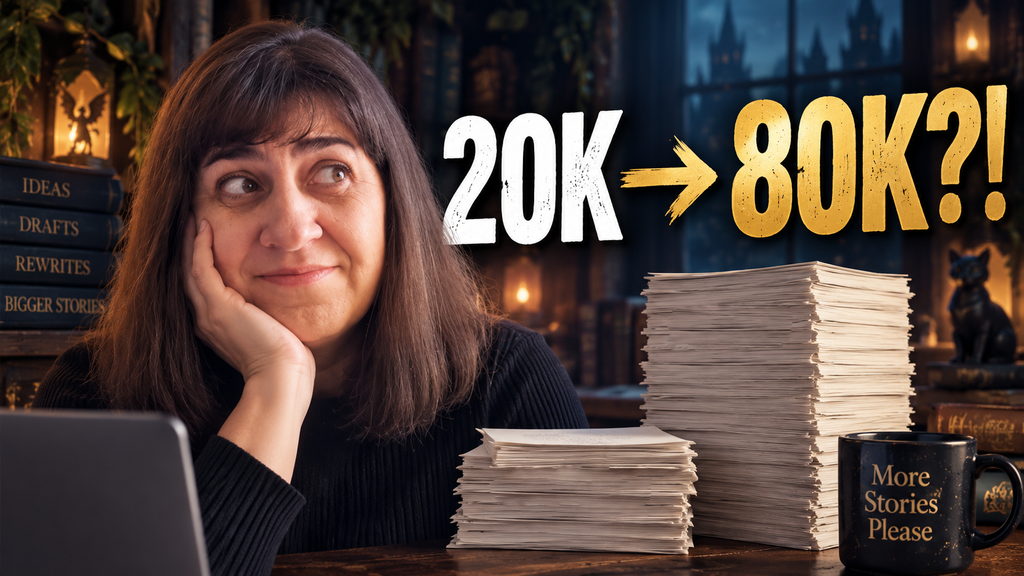
From 20K to 80K
So this is my next writing challenge.
I know I can write a 20,000-word story.
Now I want to find out whether I can write an 80,000-word one.
More importantly, I want to learn how to create a story that deserves those extra 60,000 words — a bigger plot, a richer world, more room for characters and relationships to develop, and perhaps a few story threads that don’t take the shortest possible route from Point A to Point B.
Can I do it?
I have absolutely no idea.
But I suppose we’re going to find out.
If you’re a writer, are you an underwriter like me, or do you finish your first draft and immediately need to find 30,000 words to kill? And if you’re a reader, which do you prefer: shorter, faster-paced books that you can fly through, or enormous doorstoppers that you can disappear into for weeks?
